


 Sapa Tours & Activities
Love Waterfall Sapa: The Walk, the Legend & Honest Tips
You hear it before you see it. The path bends up through bamboo and pine, following a stream that grows louder until the water is the only sound left. Then the trees pull back, and there Love Waterfall Sapa is.
Over a hundred meters of falling water, dropping down the mountain in a single thin white rope, throwing cool mist across everyone standing at the rail.
The legend is what brings people here. The walk is what they remember.

Where Love Waterfall is – and what it really is
Love Waterfall Sapa sits about 14 km southwest of Sapa town, in San Sa Ho Commune, at the foot of the Hoang Lien range. It’s no secret, and it’s not wild. The path is built up with stone steps and railings, there’s a ticket gate, and on a clear weekend, it fills with day-trippers and Fansipan trekkers passing through.
This is the official starting point for the climb to the summit, so you’ll share the lower trail with people heading much higher than the falls.
None of that takes away from it. The earlier you arrive, the quieter and more peaceful the waterfall feels.
The legend behind the name
The story goes that fairies once bathed here, and that the seventh of them fell for a young woodcutter playing his flute by the falls. Her family forbade it. Unable to reach him, she would stand in the arch of mist each afternoon, hoping to hear his music. Grief finally turned her into a bird that still circles the peak.
That’s how the “Love” Waterfall got its name — a sad story for a beautiful place, which is somehow always the way in these mountains.
The walk to the Love Waterfall Sapa
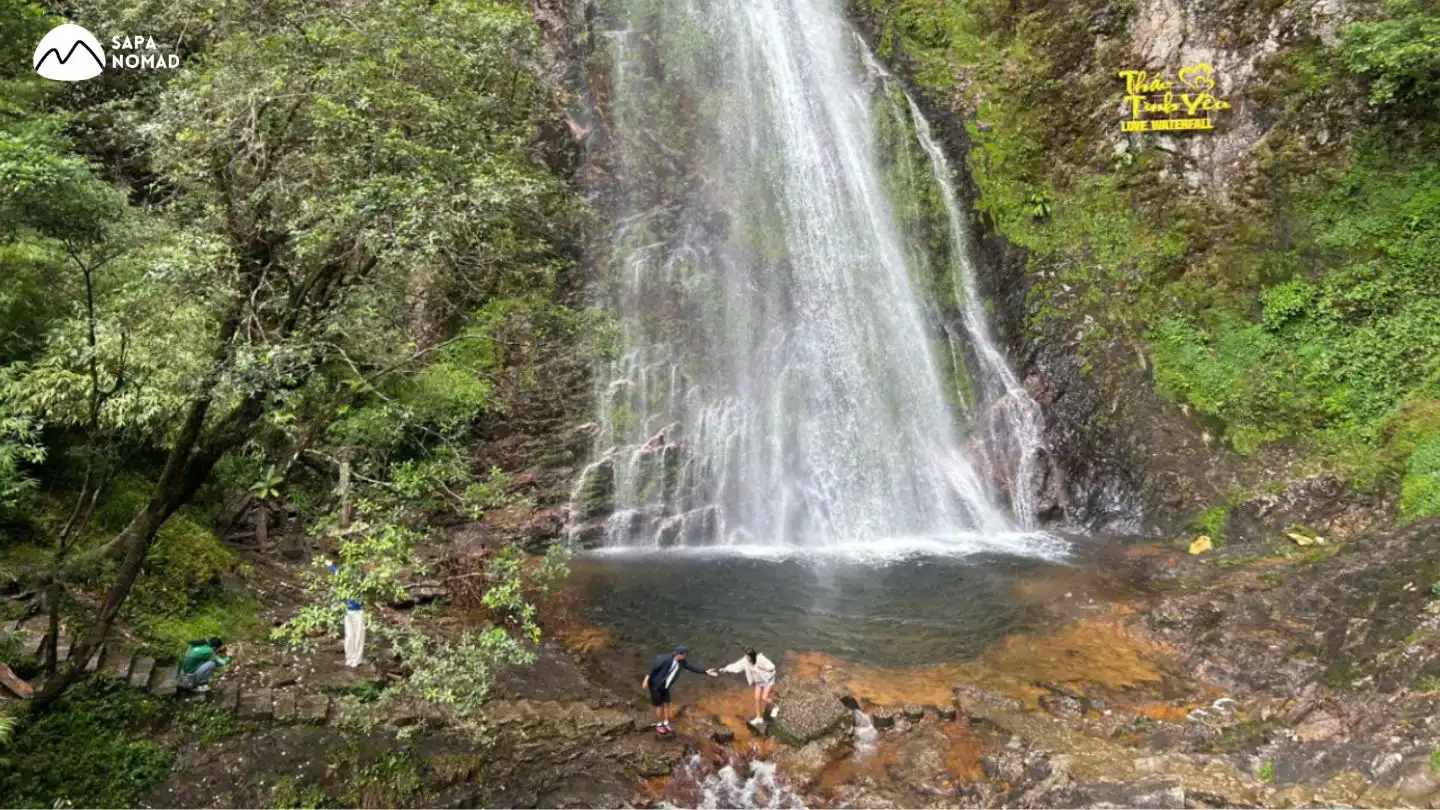
This is the part worth slowing down for. From the gate, it’s roughly 1.5 km up a forest path — stone steps, a few slippery stretches, the stream always within earshot. The trail threads through bamboo and old-growth forest, with terraced fields opening at the lower bends.
In March, the slopes are flush with wild azalea; in May and June, the myrtle comes out. You climb past mossy boulders and small side-cascades, the air cooler and greener the higher you go.
At the top, the main fall is fed by two streams meeting near the lip. That union gives the legend its “unity” and the place much of its quiet romance.
Most people stop at the foot, take the photo, and turn back. But if the water’s low, it’s worth picking your way a little higher along the rocks. Up there, the crowd thins to nothing and the fall is briefly yours alone – just spray, green light through the canopy, and the cold coming off the water. That’s the version of Love Waterfall worth the drive.
Wear shoes with real grip. I’ll be honest: after rain, those stone steps are genuinely slick, and I’ve watched more than one person in smooth-soled sneakers give up halfway. The walk is easy in dry weather and a small ordeal in wet.
Arrive before the vans
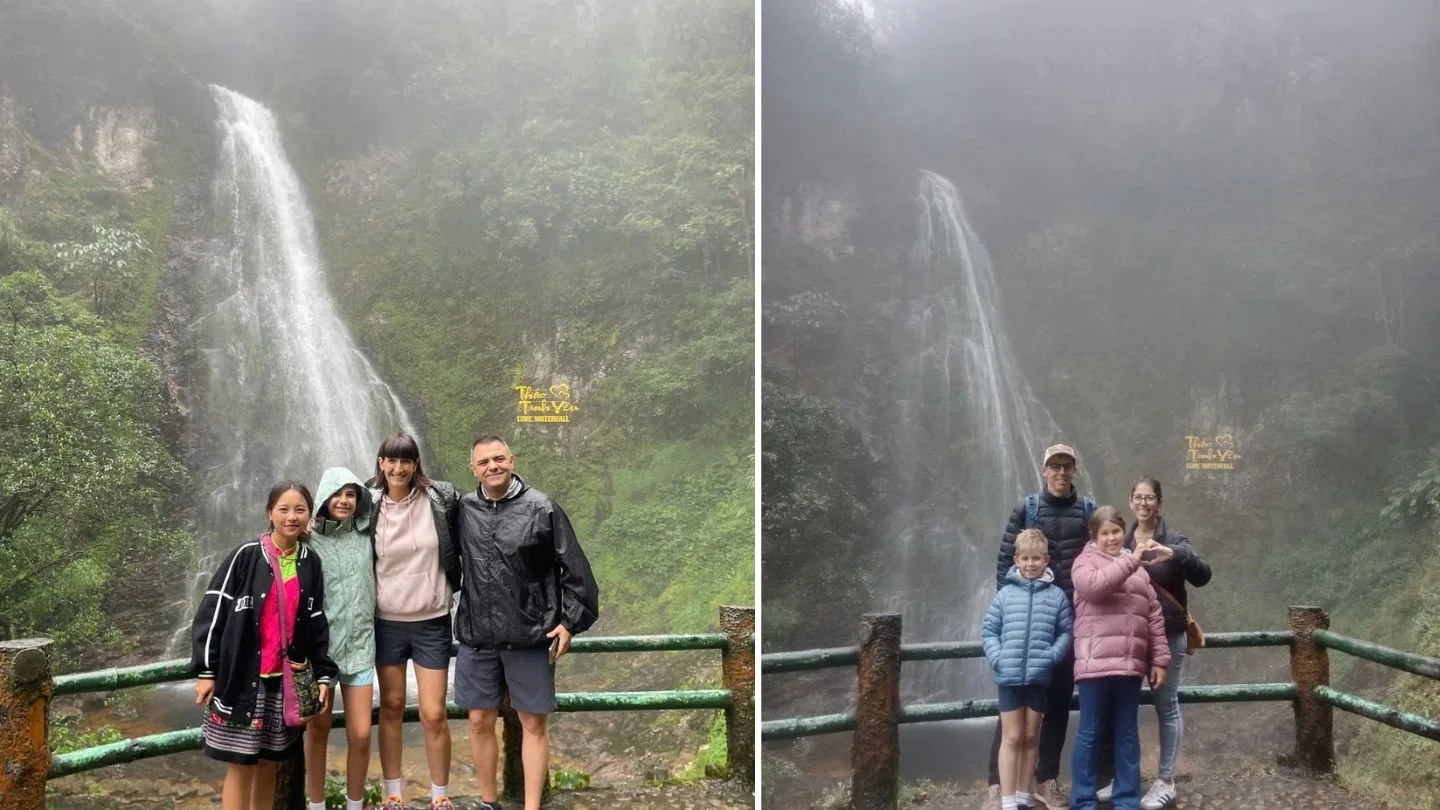
If you take one piece of advice from me, take this one. I once turned up at the gate a little after seven, the first car in the lot, and walked the whole path with nobody ahead and nobody behind. The forest still had its night-cold in it. The steps were dark with dew, and the only voices were birds and water.
At the foot of the Love Waterfall Sapa, I had the rail entirely to myself for the better part of half an hour — just the roar, the mist drifting sideways, and that strange feeling of being somewhere ancient and completely alone. By the time I was walking back down, the first vans were unloading at the gate, forty people at once, phones already up.
Same waterfall. Two different places. The early one is the one I’d drive out for again.
Getting there
By car or taxi — the simplest option for the 14 km from town; the road is paved and easy to follow.
By motorbike — the more beautiful way if you ride, winding past terraced fields and villages on the road toward Fansipan.
As the start of a Fansipan trek — if you’re climbing Fansipan on foot, the falls are your first landmark on the way up.
Best time, entry, and what to bring
Best time. The dry months — September to November and March to May — give the cleanest light and the safest path. The falls run hardest right after the rains, but that’s also when the trail is most treacherous and the mist heaviest.
Entry. A ticket is required at the gate — about 70,000đ per adult and 30,000đ per child, paid cash at the booth.
Bring. Shoes with grip, a light layer (the mist keeps the air cool even in summer), water, and a snack, and a dry bag for your phone if you’re going near the spray. Still, bring quick-dry clothes and a little insect repellent for the forest.
Is Love Waterfall worth it?
Come early, walk slowly, and it’s one of the most restful half-days near Sapa. Arrive at noon on a holiday, and there’s a queue to a viewpoint. Timing is everything here.
FAQs
Can you swim at Love Waterfall?
Yes, swimming is possible at Love Waterfall Sapa. I’d recommend visiting between May and July, when the waterfall is at its fullest. From October onward, water levels tend to drop, although the water stays refreshingly cold throughout the year. Just be careful near the base of the falls, as some sections can be surprisingly deep.
How much does it cost to go to Love Waterfall?
A ticket at the gate runs about 70,000đ per adult and 30,000đ per child, paid in cash. It’s a small charge — bring loose notes so you’re not waiting for change.
What is the name of the Love Waterfall?
It’s best known for the romantic legend behind its name, which adds a little extra charm to the experience. If you’re visiting Sapa with your partner or simply looking for a quieter, more scenic hike – this is one place I’d happily recommend.
What’s the best time to visit?
The dry seasons, September–November and March–May, for the safest path and clearest views. March brings azalea blooms on the slopes; May and June bring myrtle.
→ Comparing the area’s cascades? See Silver Waterfall, or browse more things to do in Sapa.
You’ll drive back to town with damp sleeves and wet shoes. Within an hour, the Love Waterfall Sapa will have shrunk to a few photos on your phone. But the next quiet morning, somewhere far from here, a stream will get louder around a bend in some other trail. And for a second, you’ll be standing back at the rail in the mist, listening.
Related Tours & Transport
